
Mahama: Macroeconomic Stability Has Brought Back Business Confidence
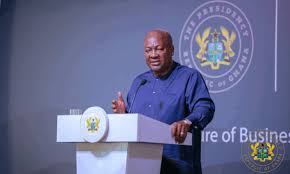
President John Dramani Mahama has declared a strong resurgence in Ghana’s business environment, citing improved macroeconomic stability, lower interest rates, and rising investor confidence.
Speaking at the Kwahu Business Forum under the theme “The Future of Business: The Role of the Financial Sector,” he emphasized that the country’s economic direction has shifted positively compared to previous years.
According to the President, the atmosphere for both domestic and foreign investment has significantly improved. He noted that business confidence, which had been subdued in recent years, is now returning as key economic indicators begin to stabilize.
“I’m happy to report that since the last time we met here, the business environment is much, much, much better than it was before,” he stated, pointing to a noticeable increase in both foreign direct investment and local investment activity.
Credit Access
A central theme of the President’s remarks was the government’s reduced reliance on borrowing, which he said has created space for private sector growth.
By cutting down on borrowing from treasury markets and commercial banks, the government has eased the pressure that previously limited access to credit for businesses.
He explained that banks now have more liquidity available for lending, shifting the focus toward private sector financing. This change is expected to stimulate business expansion and entrepreneurship across various sectors of the economy.
President Mahama noted that treasury bill rates have declined, making them less attractive for investors. As a result, financial institutions are more inclined to lend to businesses rather than invest heavily in government securities.
“The banks now are holding huge liquidities and they must find somebody to lend it to because government won’t take it,” he explained, adding that this development presents a significant opportunity for businesses seeking capital.
Falling Interest
The President highlighted a sharp decline in interest rates as one of the most impactful changes in the financial environment. He contrasted current lending rates with those of previous years, illustrating how the cost of borrowing has become more manageable for businesses.
“Interest rates in 2024 were about 32 percent. Today, I heard of somebody who borrowed at 10 percent, 9 percent,” he said, describing the shift as a major improvement for the business community.
This reduction in borrowing costs is expected to encourage investment, expand operations, and support the growth of small and medium enterprises. Lower interest rates also enhance the ability of businesses to plan and execute long-term strategies with greater confidence.
Confidence
Beyond credit access, the President pointed to declining inflation as a key factor supporting economic recovery. Lower inflation, he noted, allows for more predictable pricing, which is essential for both businesses and consumers.
The stability of the Ghanaian currency was also highlighted as a critical achievement. According to Mahama, a stable currency has made the investment environment more predictable and reduced uncertainty for importers and exporters.
He explained that the strengthening of the cedi has led to lower costs at the ports, particularly in terms of duties and levies calculated in local currency. This, he said, removes incentives for practices such as under-declaration of imports.
“Today, you are paying the equivalent of about 10.9 cedis to the dollar, so it means automatically your duties and levies have come down in cedi terms,” he noted, urging importers to comply fully with regulations.
External Shocks
While acknowledging the progress made, the President stressed the importance of building a resilient economy capable of withstanding global shocks.
He noted that external events, including geopolitical tensions, remain unpredictable but emphasized that Ghana is better prepared than before.
He cited the country’s improved external position, including strong export cover and adequate petroleum reserves, as indicators of resilience.
According to him, Ghana currently has nearly six months of export cover and sufficient fuel reserves to avoid supply disruptions.
“So far, our economy has shown some resilience,” he said, referencing global tensions and their potential impact on energy markets. He assured that measures are in place to prevent shortages and maintain stability in critical sectors.
Macroeconomic Stability
The President underscored that the government’s primary focus has been on restoring macroeconomic stability, which he described as the foundation for sustainable growth.
By stabilizing key indicators such as inflation, interest rates, and the exchange rate, the government aims to create a more predictable and business-friendly environment.
He reiterated that the goal is not only to recover from past challenges but also to build an economy that can adapt to future uncertainties. This approach, he noted, is essential for maintaining investor confidence and supporting long-term development.
Comments are closed.