
Otumfuo Gives Bawku Peace Mediation Report to Mahama
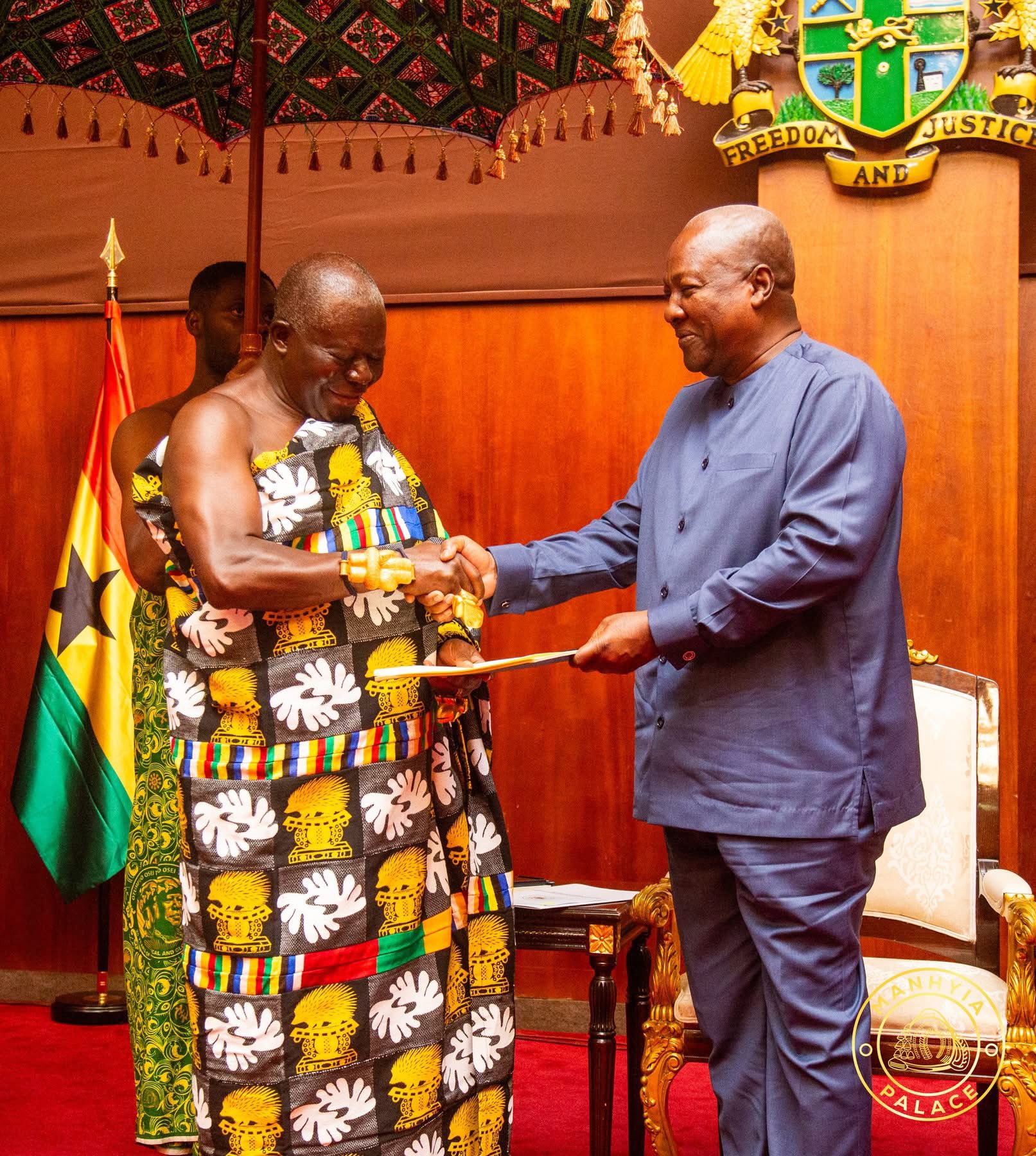
The Asantehene, Otumfuo Osei Tutu II yesterday, December 16, 2025 led a high delegation of Chiefs from the Ashanti Region to the seat of government in Accra to officially present the Bawku Peace Mediation Report to President John Mahama aimed at fostering lasting peace in the troubled Bawku township.
The presentation, the Asantehene explained is a critical step towards ending the cycles of violence in Bawku and building a foundation for reconciliation and lasting coexistence.
The peace mediation, Otumfuo Osei Tutu said has been in existence for almost two and a half years since he was invited by the former President, Nana Akufo-Addo’s government to mediate.
Speaking at the event which was held at the Jubilee House, Otumfuo Osei Tutu II said his mandate was to establish facts and lay the groundwork for peace, not to pass judgment.
“I’m here not to give a judgment as to who was wrong and who was right. I’m here to present the facts as they are for us to have peace. Almost a year ago, the people of Ghana handed the mandate of the governance of Ghana to your Excellency, and you wasted no time in reaffirming the mandate of the Bawku mediation. By the grace of God, we are able to assemble here for us to present to your excellency the report of the mission you entrusted to us.
“We present the report for your kind consideration, whatever action you and your government consider appropriate. Like I said, it was a mediation. It wasn’t an arbitration, and I’m not here to say that this one was wrong or this one was right. I’ll present the facts as they are, and that of what it should be, binding on all of us” he stated.
He continued, “The parties in this dispute have willingly submitted themselves to the mediation process. The Bawku Naaba has accorded me enormous respect and personally led his delegation at all times to my palace. Whenever I invited, my brother the Nayiri, for very good reasons, sent a delegation of his elders and such chiefs at all times that I have requested him to come. They all express confidence in the process and believe that we will be able to work towards an amicable outcome”.
Government Response
President John Mahama after receiving the report said, his government would adopt a firm and precise approach in the next 24 hours to intensify peace and advance reconciliation between the feuding factions.
“I’m pleased that this mediation has come to an end, and that a report has been presented. I can assure him (Otumfuo) that government will look at this report, and within the next 24 hours, government will issue a statement on its definitive position on the report.
He added, “But it’s my hope, that the National Peace Council, the House of Chiefs, Otumfuo himself, and all the religious bodies would go the next step of continuing the engagement between the Nayiri and the Bawku Naaba to ensure that we are able to bring reconciliation between the two groups.”
Background
The Bawku Chieftaincy dispute is a decades-long conflict between the Mamprusi and Kusasi ethnic groups in Ghana’s Upper East Region, centered on who rightfully controls the paramount chief’s stool (the Bawku Skin).
Originating in colonial policies that disrupted traditional leadership, it escalated after independence with political interference, leading to rival chiefs, ethnic divisions, and recurring violence, with the Mamprusi claiming historical legitimacy and the Kusasi challenging it.
Historical Explanations
Otumfuo providing historical aspect to the conflict, explained that when the British arrived in Bawku in 1901, they were dissatisfied with the existing Tendana system, which recognised earth priests as custodians of the land.
He said the colonial administration subsequently adopted aspects of the chieftaincy system, appointing chiefs from among Tendanas where possible, and selecting other individuals in areas where qualified Tendanas could not be identified.
Otumfuo stated that the Kusasi maintain it was during this period that the Mamprusi presented themselves to the British as chiefs of their ethnic communities and were subsequently recognised and registered. He emphasised that the position of Tendana was never abolished and continued to exist alongside the introduced chieftaincy structure.
He noted that tensions escalated when some Mamprusi chiefs allegedly abused their authority over Kusasi landowners, prompting the Kusasis to remove Mamprusi chiefs and install their own.
According to the Asantehene, following the death of the last Mamprusi chief in 1956, the Kusasis selected Abugrago Azorka I as Bawku Naba in 1957. After his death in 1983, his first son was chosen in 1984 to succeed him as Zugraan Bawku Naba Asigri Abugrago Azorka II, a position he continues to hold.
Comments are closed.